

Virtual Expansion Test
The coefficient of thermal expansion of a mix, from a length-change test on a 3D concrete specimen built particle by particle, with the stiffness and expansion of every ingredient.
Strain against temperature
The specimen is brought to a series of uniform temperatures and left free to expand. Each stone, sand grain and air void, and the paste between them, has its own elastic modulus, Poisson's ratio and expansion coefficient, so the stiff stones hold back the paste as it expands. The slope of the specimen's strain against temperature is the CTE of the concrete.
Each test is a full 3D finite element analysis and runs on the same machine as the thermal stress analyzer, so it needs the analyzer beta. The same specimen can run the cooling test too.
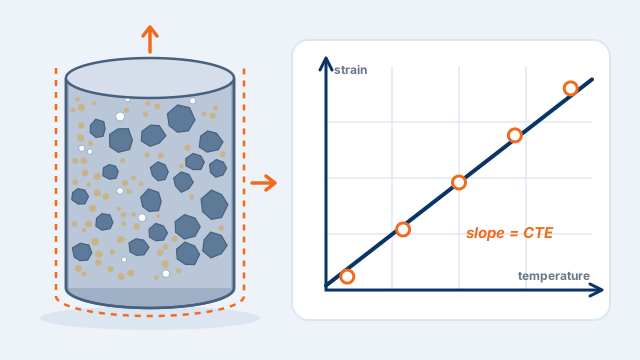
From the ingredients to CTE
Every ingredient
Elastic modulus, Poisson's ratio and expansion coefficient of the cement paste, sand and stone; air voids carry no load.
Uniform temperatures
Like a length-change test: the specimen is held at several temperatures, 10 to 50 °C by default, free to expand.
Strain and slope
Axial (length change), lateral and volumetric strain against temperature, and the CTE from their slopes.
Straight to the analyzer
The CTE goes to the thermal stress analyzer's Material tab, or into a parameter file to load later.