

Mass concrete engineering
Analytical Tools for Durable Mass Concrete Structures
The basics
What is Mass Concrete?
“Any volume of concrete with dimensions large enough to require that measures be taken to cope with the generation of heat from the hydration of cement and attendant volume change to minimize cracking.” American Concrete Institute (ACI)
Concretetherm aims to improve the performance, safety, and durability of mass concrete bridge substructures.
Heat of hydration
How Do Thermal Stresses Develop?
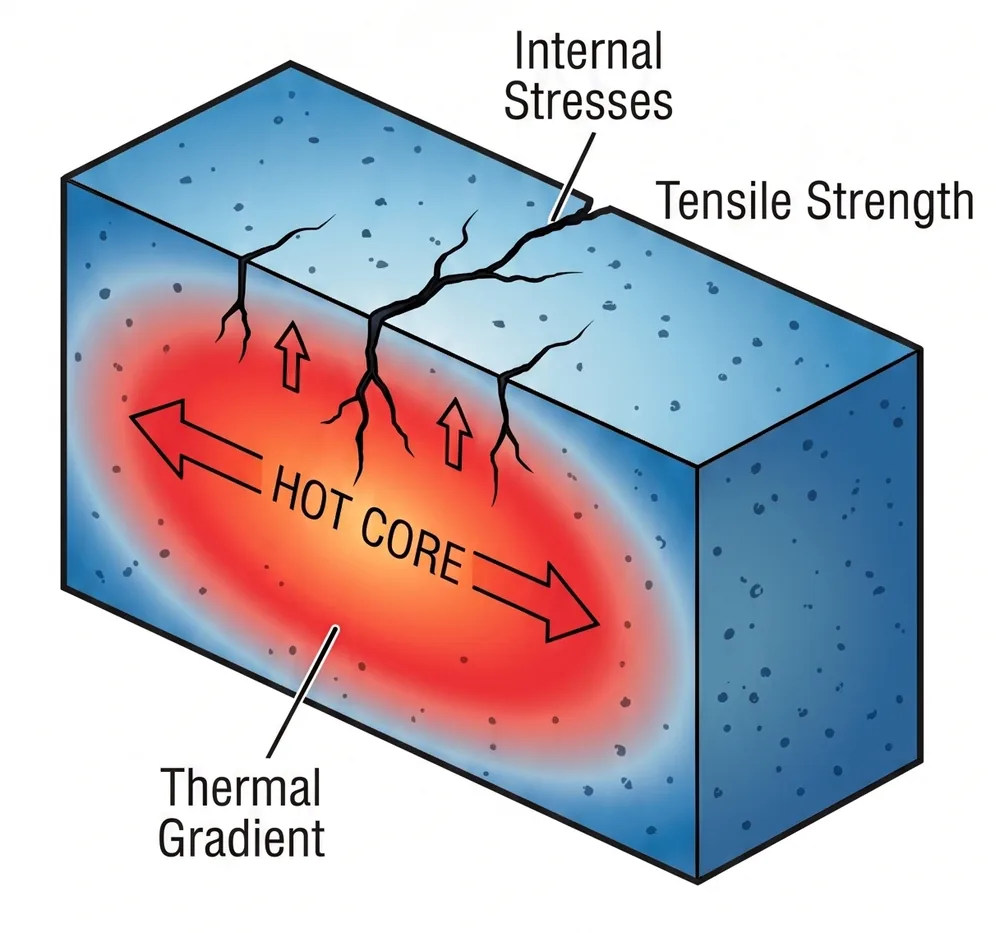
- In mass concrete structures, the temperature rise caused by cement hydration can be significant, leading to internal thermal expansion.
- At the same time, heat is rapidly dissipated from the exterior surfaces, resulting in large temperature gradients.
- These gradients induce tensile stresses at the concrete surface.
Apply the available tools to evaluate thermal loading and the resulting maximum tensile stresses in mass concrete.
Durability
What is Thermal Cracking?
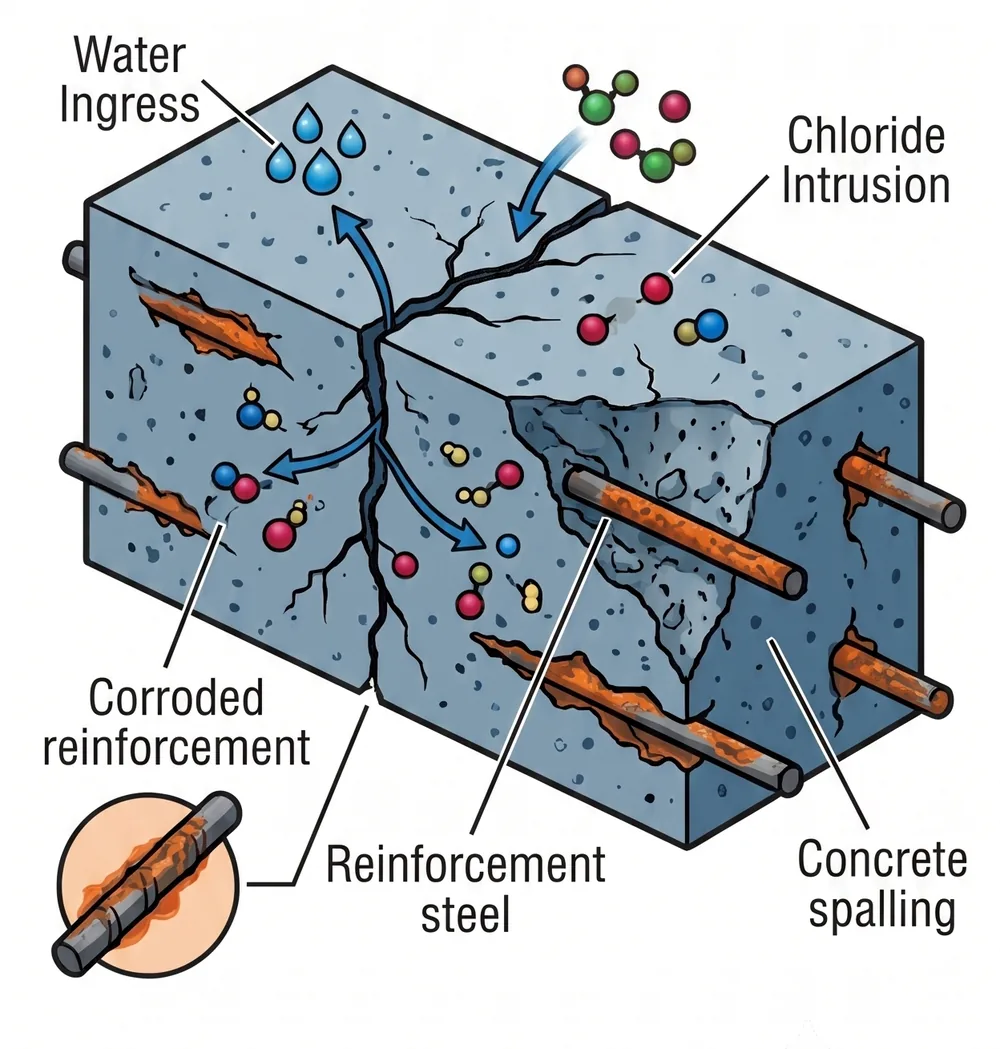
- When the thermal stresses exceed the concrete’s tensile strength, cracking is highly possible.
- Thermal cracking compromises durability, and accelerates reinforcement corrosion.
- Thermal cracking can be mitigated by controlling temperature differentials through improved mix design, effective insulation, and proper formwork removal timing.
- Accurate material modeling and 3D thermal–stress modeling are essential for the estimation of thermal stress magnitude and cracking prevention.
Using 3D numerical analysis, cracking risks can be investigated and therefore prevented.
Numerical analysis
3D Finite Element Modeling
3D Transient Thermal Modeling
- A 3D transient thermal model analyzes time‑dependent heat transfer inside a structure.
- It calculates how temperature rises, falls, and spreads due to conduction, convection, and radiation.
- This type of model is used when thermal conditions are not steady and must be tracked dynamically to identify hot spots, cooling rates, and thermal gradients.
3D Thermal Stress Modeling
- A 3D thermal stress model uses temperature data, often from a thermal simulation, to determine how a structure expands, contracts, or warps due to heating and cooling.
- It calculates resulting stresses, strains, and potential failure points.
Tools
Explore the Tools
From material properties to full 3D thermal stress analysis.
Laboratory & field
Material Modeling
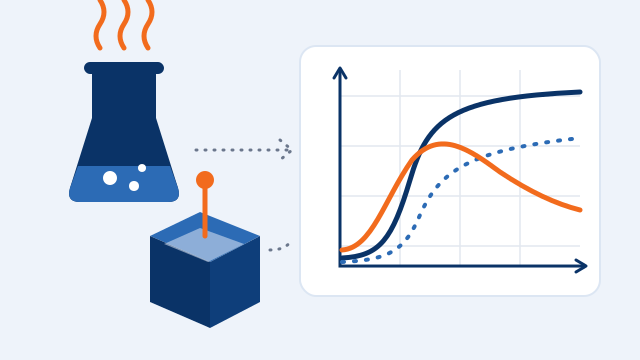
Heat of hydration, adiabatic temperature rise, compressive strength and elastic modulus, plus the on-site insulated cube for concrete as delivered.
Open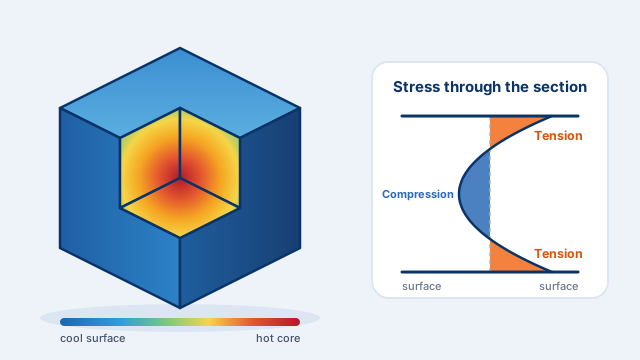
3D analysis · Beta
Thermal Stress Analysis
3D transient thermal and early-age stress analysis with cracking risk.
Open
Research
Latest Mass Concrete Publications
Loading the latest publications…